GEM Mining Consulting's analysis highlights that the ability to process and deliver critical minerals is as crucial as mining them by 2035.
According to recent insights from GEM Mining Consulting, the future of critical minerals like copper, lithium, nickel, cobalt, battery-grade graphite, and magnet rare earths hinges significantly on reliable processing and delivery, rather than just the volume mined. This shift in focus reflects broader trends within the energy transition, where the demand for these minerals continues to surge due to their essential roles in renewable energy technologies and electric vehicles.
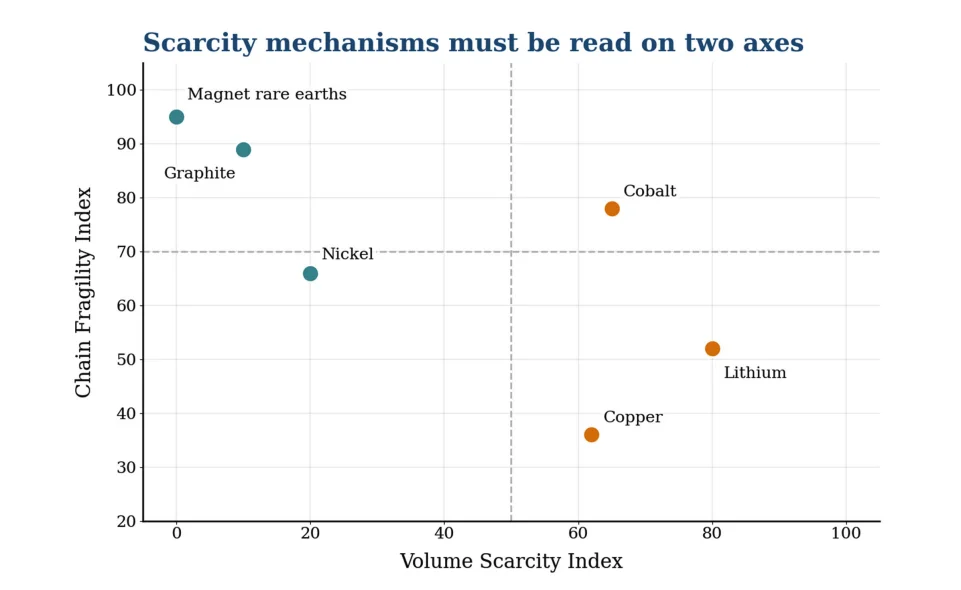
Using projections from the International Energy Agency’s 2035 outlook, GEM's analysis reveals anticipated supply will meet only 68% of lithium needs, 74% for cobalt, and 75% for copper. Such projections aren't just numbers; they’re alarm bells for industries reliant on these minerals. Despite these deficiencies, some minerals showcase counterintuitive strengths: graphite and magnet rare earths are projected to achieve supply levels of 96% and 107%, respectively, but present severe vulnerabilities in their supply chains, scoring 89 and 95 on GEM's fragility scale. This duality raises questions about how companies can navigate future market instabilities.
Volume Pressure and Fragility Insights
Lithium emerges as the most constrained mineral with a score of 80 on the Volume Scarcity Index, while copper fares slightly better at 62. Cobalt represents a dual challenge, facing both a supply deficit and a significant fragility score of 78. Nickel showcases a different scenario; it's expected to cover 92% of demand, yet its fragility, driven by dependency on Indonesia-China supply chains and limited refining options, sits at 66. These assessments of scarcity and fragility reveal the interconnectedness of supply and processing, and how political and economic factors can frequently disrupt the flow of essential materials.
This disparity in reliability highlights a critical need for tailored solutions, suggesting that copper, lithium, and cobalt require consistent project development. The situation is not just about digging these materials out of the ground; it's about ensuring they get processed, refined, and delivered on time. Meanwhile, graphite and magnet rare earths call for diversified processing capabilities along with a broader customer base. It's a puzzle that requires strategic foresight, where companies may need to think beyond standard supply chains and foster relationships across different sectors. If you're working in this space, understanding these dynamics is essential for navigating the risks involved.
Addressing Overstated Production Capacities
GEM further emphasizes that projected production capacities often exaggerate actual future supply due to various factors including commissioning delays, product quality issues, and operational challenges. There’s often a gap between expectation and reality. For instance, a hypothetical project with a nameplate capacity of 100,000 tonnes could realistically deliver only 60,200 tonnes under typical conditions. Understanding this gap is essential for planning, investment, and risk management.
This scenario underscores a vital aspect: smaller mining operations that excel in processing and customer qualification can possess greater strategic importance compared to larger projects that struggle to reach viable market paths. In many cases, agility trumps size in the current mineral market. While larger operations have economies of scale, they might not always navigate the complexities of regulations and local market conditions as effectively as smaller entities. Ultimately, the realization of critical minerals as reliable supply involves navigating a complex process that extends beyond mere reserves. They must be financed, permitted, mined, processed, and effectively delivered to be genuinely viable. And that's the part most people overlook.
Implications for Market Players
The insights from GEM Mining Consulting don't just shed light on current shortages; they signal a significant recalibration in how industries must approach sourcing critical minerals. Companies must rethink their strategies for securing stable supplies. This could involve investing in partnerships with reliable smaller firms that have proven track records in processing efficiency rather than solely relying on volume outputs from larger, traditional mines.
Moreover, the fragility scores assigned by GEM indicate that supply chain disruptions could have widespread implications. A crisis in one area could ripple through the markets, affecting everything from electric vehicle manufacturing to renewable energy projects. Market players need to prepare for these challenges by enhancing their knowledge of supply chain vulnerabilities and considering alternative sources. If this all sounds daunting, it is. But recognizing these pressures now can lead to better preparedness for what's to come.
In short, the future of critical minerals isn't just about what's mined; it's about how reliably it’s processed and delivered. As demand continues to grow alongside global sustainability efforts, securing these minerals may require a shift in perspective—one that accounts for the fragile nature of their supply chains and the operational capabilities of miners. The market landscape is complex, and the road ahead might be bumpy. But with the right strategies, there's potential to navigate it effectively.
Discussion
Sign in to join the discussion.