Copper prices soar as US inflation calms interest rate fears and supply shortages become acute, especially in London, resulting in notable market shifts.
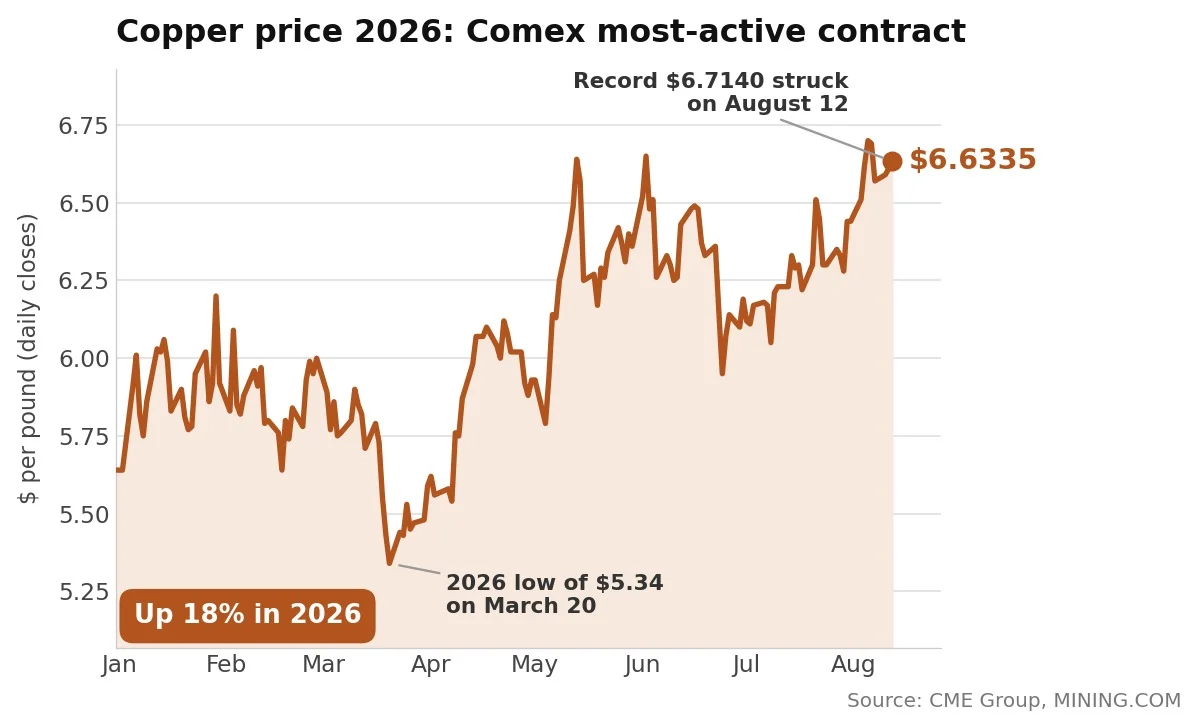
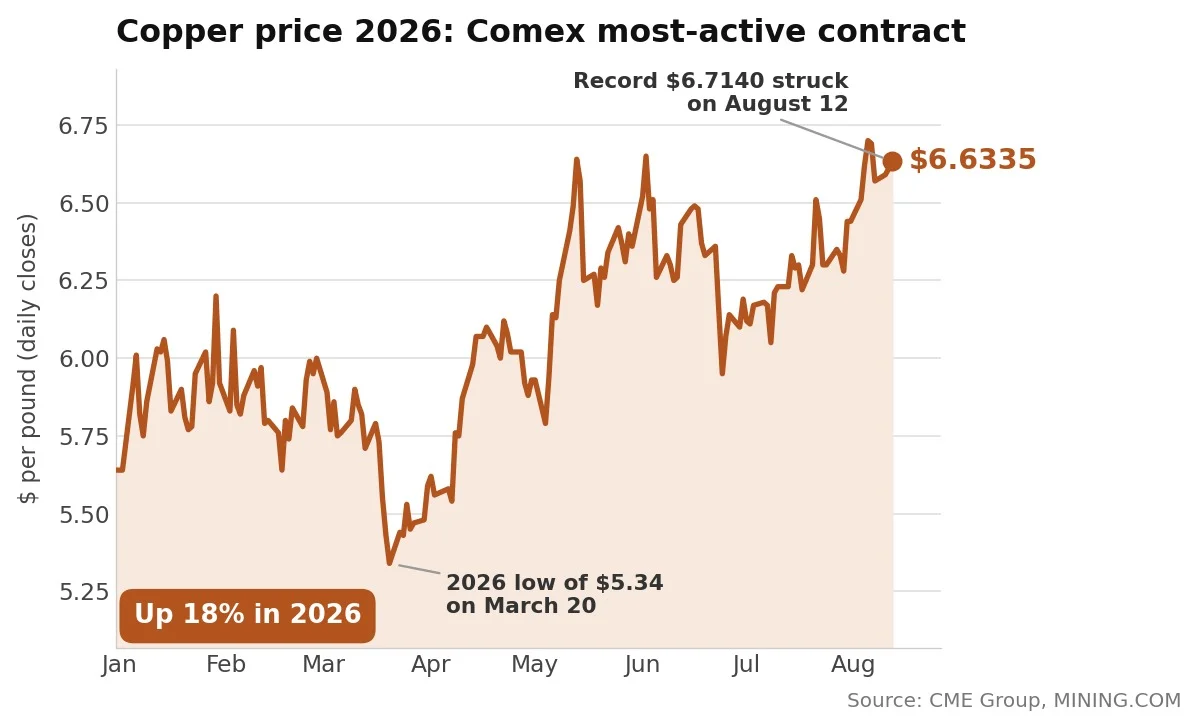
Copper prices on the Comex reached a new milestone on Wednesday, driven by a benign inflation report from the US that lessened fears of further interest rate hikes, coupled with a physical squeeze in London that pushed premiums for immediate delivery to their highest levels this year.
Price Movements and Market Dynamics
For September delivery, copper peaked at $6.7140 per pound ($14,802 per tonne) in New York, surpassing the previous record of $6.7045 set on August 5, before settling slightly lower at $6.6335. The December contract touched $6.8070, while deliveries in September 2027 traded at $7.0280 per pound. This strong performance highlights a growing investor interest in copper, a metal increasingly viewed as essential for green technologies and infrastructure projects. As global economies shift towards renewable energy and electric vehicles, the demand metrics for copper are likely to escalate, positioning it as a critical commodity in the years ahead.
Cash copper on the London Metal Exchange closed at $14,424.50 per tonne on Tuesday, indicating a premium of $207.50 over the three-month contract priced at $14,217.00. This backwardation reflects heightened demand for immediate supply, increasing from $138 the previous day and just $34 at the beginning of July. Notably, LME warehouse stocks have decreased to 214,550 tonnes, a significant reduction of over 35,000 tonnes or 14% since the end of July. Comex copper currently trades approximately $400 above the London three-month price. This difference points to a growing physical market tightness, which can often trigger further price increases, especially if inventory levels continue to decline. The relationship between immediate supply and futures pricing can set a trajectory for market expectations over the coming months.
Emerging Projects with Potential
In a noteworthy development, Bougainville's autonomous government has authorized Lloyds Metals & Energy from India to move forward with preparatory and feasibility studies at the Panguna copper mine in Papua New Guinea, which has remained closed since 1989 due to civil unrest linked to environmental and revenue-sharing disputes. The site is estimated to contain around 5.3 million tonnes of copper and 19.3 million ounces of gold, valued at approximately $160 billion based on current market prices. The situation surrounding Panguna is tangled with deep local issues, including community relations and environmental concerns that remain unresolved. Such complexities often delay project timelines, despite significant underlying value.
Lloyds, an iron ore producer, won out against China’s CMOC Group for this opportunity. The project, which is seen as pivotal for funding independence efforts in Bougainville, still requires further approvals before proceeding to the construction and production stages. Managing Director Rajesh Gupta indicated that the feasibility analysis is ongoing. Should these approvals be granted, and the company navigate local sentiment successfully, it could be a substantial contributor to global copper supplies in the future.
Concurrently, SM Investments, managed by the family of the late Henry Sy, plans to transfer its 34% stake in Atlas Consolidated Mining and Development to Dominion Holdings by next year. There's a potential consolidation at play with Tandakan, the largest copper and gold deposit in the Philippines, anticipated to launch in 2028, which is two years behind its original schedule. This venture is projected to yield an average of 375,000 tonnes of copper and 360,000 ounces of gold in concentrate annually over 17 years. Remarkably, Dominion's shares surged by 821% in 2026, starkly contrasting with the Philippine index's mere 5.2% increase. The stark difference in performance indicates that investors might be increasingly confident in the future trajectory of copper markets, valuing anticipated growth in emerging projects over traditional benchmarks.
Sweden has cleared two appeals against Boliden’s mining concession at Laver, allowing the company to seek an environmental permit for a deposit estimated at 849.5 million tonnes with a copper grade of 0.24%, equivalent to roughly 2 million tonnes of contained metal. Boliden posits that Laver could potentially double Sweden's copper production, bolstering Europe’s self-sufficiency in the metal by about 10%. Boliden Mines president Stefan Romedahl expressed strong confidence in the deposit's ability to significantly enhance Europe’s copper independence. If successful, Laver could emerge as a critical asset amid Europe’s increasing reliance on copper for energy transition technologies.
Mining Sector Performance
Despite the copper price rally, several mining stocks have struggled to keep pace. Ivanhoe Mines and First Quantum Minerals gained 18% and 14%, respectively, since late July, contrasting with only a 2.5% rise in copper metal itself. Meanwhile, Teck Resources and Freeport-McMoRan saw stock increases of 11% and 10%, respectively. Others like Zijin Mining and Jiangxi Copper reported gains in the 8% to 9% range, with Vale slipping 4% in the same timeframe, and CMOC down by 5.2% in Hong Kong trading on Wednesday. This discrepancy raises questions about the broader health of the mining sector. If copper prices are soaring, one would typically expect mining stocks to follow suit, but this isn’t always the case. Surprisingly, gold miners have experienced price increases significantly outpacing those of copper miners over the same period, suggesting that investor sentiment may have shifted, favoring perceived stability over commodity-specific growth.
Cumulatively, copper has risen by about 18% in 2026 and boasts a substantial 47% rise over the past year. The ongoing price volatility, combined with inconsistent stock performances, suggests a complex market sentiment. This lack of synchronicity could indicate risk factors that investors must navigate carefully.
Implications for the Future
What does this all mean for the future? The dynamics presented here underline a shift in focus not only towards immediate copper demand but also the long-term viability of newly emerging mining projects. If you're working in this space, understanding the underlying local challenges and market reactions to copper prices will be key. Investors may want to watch geopolitical factors and supply-demand intricacies closely as these elements could significantly influence market stability.
The resurgence of projects like Panguna and Laver speaks to regulatory changes and evolving economic conditions that could reshape copper's supply chain. As traditional mining regions face increasing restrictions, more untapped sites may become focal points. This could signal a wave of new investment but also unease among local communities affected by potential mining operations. As the copper market heats up, the balancing act between economic gain and social responsibility is more critical than ever.
(With files from Bloomberg)
Discussion
Sign in to join the discussion.