Copper prices are approaching record levels due to supply disruptions at the Grasberg smelter, while aluminum sees gains from output cuts in Brazil.
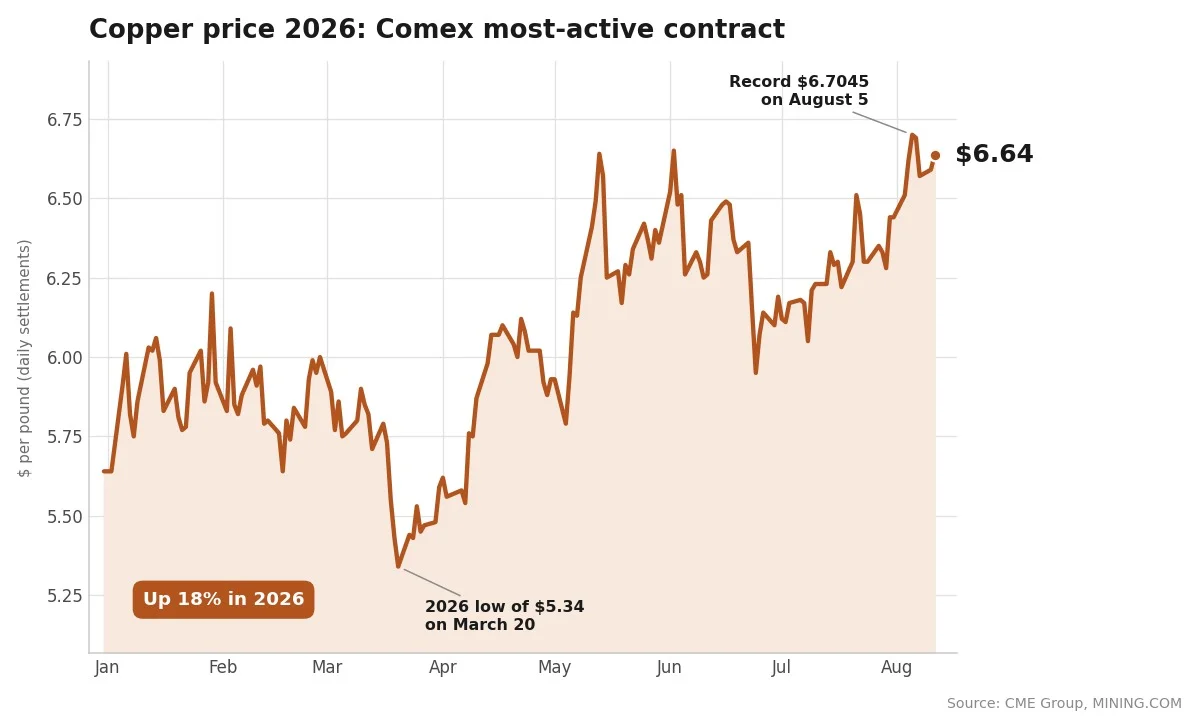
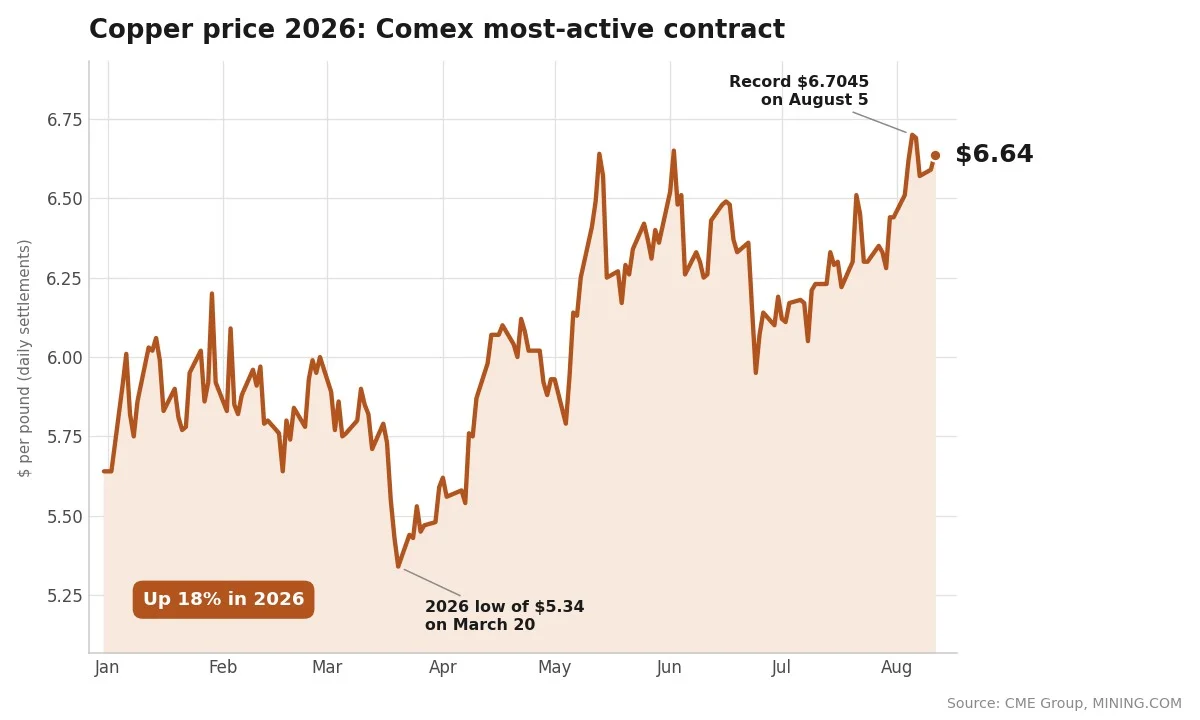
Copper is approaching historic price levels, riding a wave of supply disruptions. An outage at the Gresik smelter, which processes ore from the Grasberg mine, is exacerbating an already tight market. As a result, London benchmark prices have remained above $14,000 a tonne for a sustained period, with copper touching $6.7005 a pound ($14,772 a tonne) on the Comex, just shy of the record $6.7045 set in early August.
Current Market Dynamics
On the Comex, after peaking at $6.7005, copper settled slightly lower at $6.6360, marking a 0.3% increase for the day. Meanwhile, longer-term contracts also gained traction, with December contracts hitting $6.7980 and prices for the latter half of 2027 exceeding the $7 per pound mark. The London Metal Exchange (LME) saw three-month copper prices stabilize at $14,195.50 a tonne, creating a significant Comex premium of about $435.
These upward trends in prices reflect a market under strain, particularly as copper is highly sensitive to global demand fluctuations. The increasing prices can be attributed to limited supply coupled with resilient demand from various sectors such as construction and electric vehicles, which are driving the need for copper components. Additionally, concerns about inflation and currency fluctuations often lead investors to view commodities like copper as safer assets.
Supply Constraints and Their Impact
With cash metal settling $138 above the three-month contract on Monday, signals of physical scarcity are becoming apparent, as LME warehouse stocks fell by 4,675 tonnes to a total of 218,300 tonnes. This shortage is partially driven by news that operations at the Gresik smelter will be halted for evaluation and repair following a boiler leak earlier this month, confirmed by Mitsubishi Materials and PT Freeport Indonesia, which jointly manage the plant.
This situation raises concerns about how long the market can sustain elevated prices based on these supply disruptions. The Gresik smelter is critical in processing ore from the Grasberg mine, one of the largest copper-gold mines globally. While analysts expect that the Manyar smelter in East Java will restart production in September, the industry is still on alert. Essentially, a prolonged disruption could tighten an already strained market further. And this is the part most people overlook: the cyclical nature of these supply disruptions can lead to volatility that resonates throughout the entire economic landscape.
Moreover, the Grasberg mine is still recovering from a mudslide last September. Full production is not anticipated until late 2027, which adds another layer of complexity to the ongoing supply issues. This sort of timeline only heightens the stakes for stakeholders invested in this market, as the implications of delayed production ripple outward.
Alumina Supply Issues
On parallel fronts, aluminum prices surged to a seven-week high due to production cuts at Norsk Hydro's Alunorte alumina refinery in Brazil. The refinery, one of the largest globally, has halved output amid natural gas supply disruptions flagged by providers. Consequently, aluminum prices in London increased by as much as 1.9%, settling 1.7% higher at $3,373 a tonne. Alumina futures also saw an uptick, closing 1% higher at 2,724 yuan a tonne in Shanghai.
Supply disruptions from the Middle East have further drained LME aluminum inventories to their lowest levels since 1990, intensifying supply-side pressures and leading analysts to forecast a possible annual shortfall exceeding 900,000 tonnes if logistical conditions do not improve. Yan Weijun from Xiamen C&D indicated that continued geopolitical instability in the region could support aluminum prices in the short term. This paints a particularly precarious scenario for aluminum suppliers and consumers alike. If you're working in this space, now's likely the time to scrutinize your supply chains closely.
Miner Stocks Under Pressure
Despite rising commodity prices, mining stocks have not enjoyed the same fortune. Shares of Freeport-McMoRan and Lundin Mining fell by 3% and 3.8%, respectively, while Vale declined by 3.9%. Other notable declines included Southern Copper, which dropped 4.5% following a recent stock split. This trend is reflected across global mining sectors, with Zijin Mining declining by 6% and Jiangxi Copper down 3.5%.
These declines appear disconnected from the rising commodity prices, raising questions about market sentiment and investor confidence in the mining sector’s ability to translate price gains into profit. One reason for this might be increasing operational costs related to supply chain issues, maintenance requirements from aging infrastructure, or rising labor costs. After all, with copper rising nearly 18% year-to-date and gaining about half its value over the past year, you'd expect miner stocks to mirror that momentum. Yet, that’s not happening, and it makes you think about how external factors may be weighing more heavily on these shares than internal dynamics.
Implications and Future Outlook
The current market dynamics in copper and aluminum reflect ongoing supply chain vulnerabilities shaped by geopolitical and economic forces. The physical scarcity of copper juxtaposed against rising demand from sectors increasingly reliant on this metal means that fluctuations could become more frequent. This is more significant than it looks — as increased pricing instability can lead to broader financial implications not only for miners but also for downstream industries.
Moreover, if disruptions continue, it could signal a shift in how industries prepare for supply chain dependencies. Increasing investment in alternative materials or more localized supply chains might become paramount as companies seek to shield themselves against such volatility. The months ahead will not only challenge businesses but also redefine strategic approaches across the market landscape.
(With files from Bloomberg)
Discussion
Sign in to join the discussion.