Brazil aims to enhance its critical minerals sector by attracting foreign investment while ensuring local processing and government scrutiny of key assets.
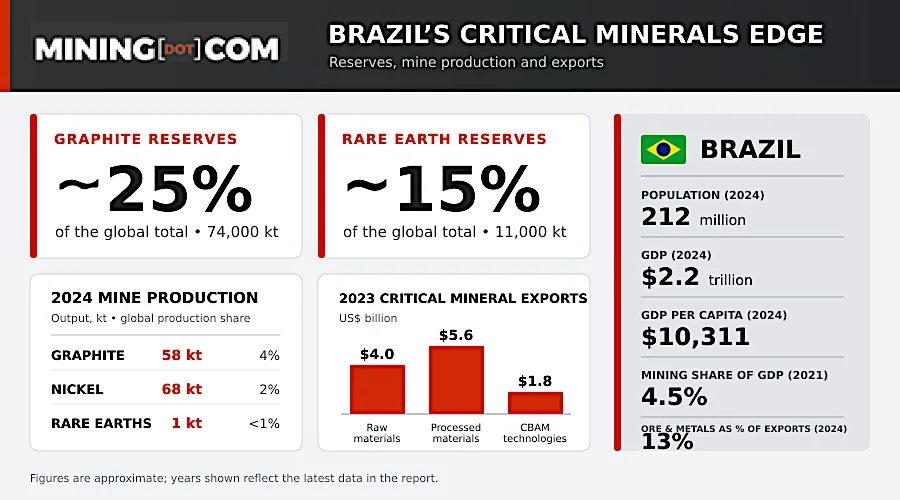
Brazil is strategically positioning itself to attract foreign investment in its critical minerals sector, emphasizing the need for domestic processing and control of valuable mineral resources. The recent approval of a bill establishing a National Policy for Critical and Strategic Minerals by Brazil's Senate underscores this intention, as it seeks to empower the government in scrutinizing the ownership and operational control of entities involved in the mining of strategic minerals.
This legislation, which awaits President Luiz Inácio Lula da Silva's signature, proposes the formation of a council directly connected to the presidency. This council is poised to monitor corporate control changes regarding firms holding rights to critical minerals, thereby mitigating substantial foreign influence and safeguarding Brazil's economic and geopolitical interests. Furthermore, the bill introduces provisions that tie export licenses to the commitment of processing minerals locally, alongside mandates for companies to disclose pertinent information such as export destinations and processing levels.
The upcoming regulations, which will elucidate transaction classifications and the council's operational mechanisms, are crucial to determining the law's impact on market dynamics. For instance, a significant transaction earlier this year saw USA Rare Earth, based in the United States, agree to acquire Serra Verde, Brazil’s sole large-scale rare earth producer, for approximately $2.8 billion. This deal includes a commitment to export initial outputs, raising concerns in Brasília, where the government aspires to foster local separation and processing capacity for rare earth elements.
Geopolitical and Industrial Implications
Brazil's endeavor to enhance its role in the global supply chain for critical minerals coincides with rising international interest in its resources. As global supply chains are realigned amidst the ongoing energy transition, numerous countries are vying for stable access to these vital resources. The Brazilian Mining Institute (IBRAM) reports a surge of inquiries from international actors, including the United States, EU, and China, regarding not only mineral supplies but also investments, technologies, and collaborative production chains.
The geopolitical landscape is notably shifting in the rare earths sector, where Western companies have emerged as key players in Brazil’s promising projects. For instance, Viridis Mining and Minerals from Australia is progressing with the Colossus ionic-adsorption clay project in Minas Gerais, while fellow Australian entities like Meteoric Resources and St George Mining are also expanding their initiatives within the country. These projects are increasingly viewed as alternatives to China's near-complete dominance in the processing and production of rare earth materials.
Klaus Petersen, Viridis’ country manager, articulated that the current context represents an international competition to establish a diversified rare earth supply chain, less reliant on China. Viridis aims to commence commercial production by 2028 and is exploring partnerships with European firms to enhance processing capabilities closer to home.
Policy Framework and Investment Incentives
The recently adopted critical minerals policy by the Brazilian government pairs increased scrutiny with incentives designed to draw investments into the sector. It includes a mineral guarantee fund of 2 billion reais (about $383 million) and a proposed program that could offer tax credits worth up to 5 billion reais ($958 million) over five years, aimed at bolstering mineral processing initiatives.
The policy is complemented by existing frameworks such as tax-incentivized bonds and financing options from governmental institutions like BNDES, the national development bank, to further support mineral projects. Brazilian lawmakers have emphasized fostering sustainable development in the critical mineral sector as a central goal of the policy.
However, striking a balance between attracting international capital and maintaining effective oversight will be imperative as detailed regulations are crafted. IBRAM has voiced the necessity for a long-term, stable policy environment that can enhance Brazil's competitiveness in mineral processing and industrialization, combined with sufficient incentives for development, research, and workforce training.
The legislative progress comes amid broader debates about the extent of government involvement in the minerals sector. Some proposed creating a state-controlled entity for managing rare earth and strategic minerals, which faced backlash from IBRAM, advocating instead for a regulatory framework focused on creating favorable investment conditions rather than direct competition with private sectors.
While the current legislation refrains from establishing such a government-run company, the parliament has granted the state a substantial advisory role in determining project eligibility for support and oversight of significant transactions involving strategic mineral assets. As Brazil’s mineral wealth continues to attract foreign interest, the major challenge remains whether the government can leverage this situation to catalyze investment while ensuring that processing and industrial benefits accrue domestically.
*Gabriel Garcia is a journalist at CNN Brazil, based in Brasília, focusing on mining, infrastructure, and economic policy, particularly in the context of critical minerals.
As global powers increasingly focus on controlling critical minerals and the supply chains associated with them, Latin America has become a focal point. Future developments in Brazil's policies will be crucial to observing global trends in this sector.
Discussion
Sign in to join the discussion.